

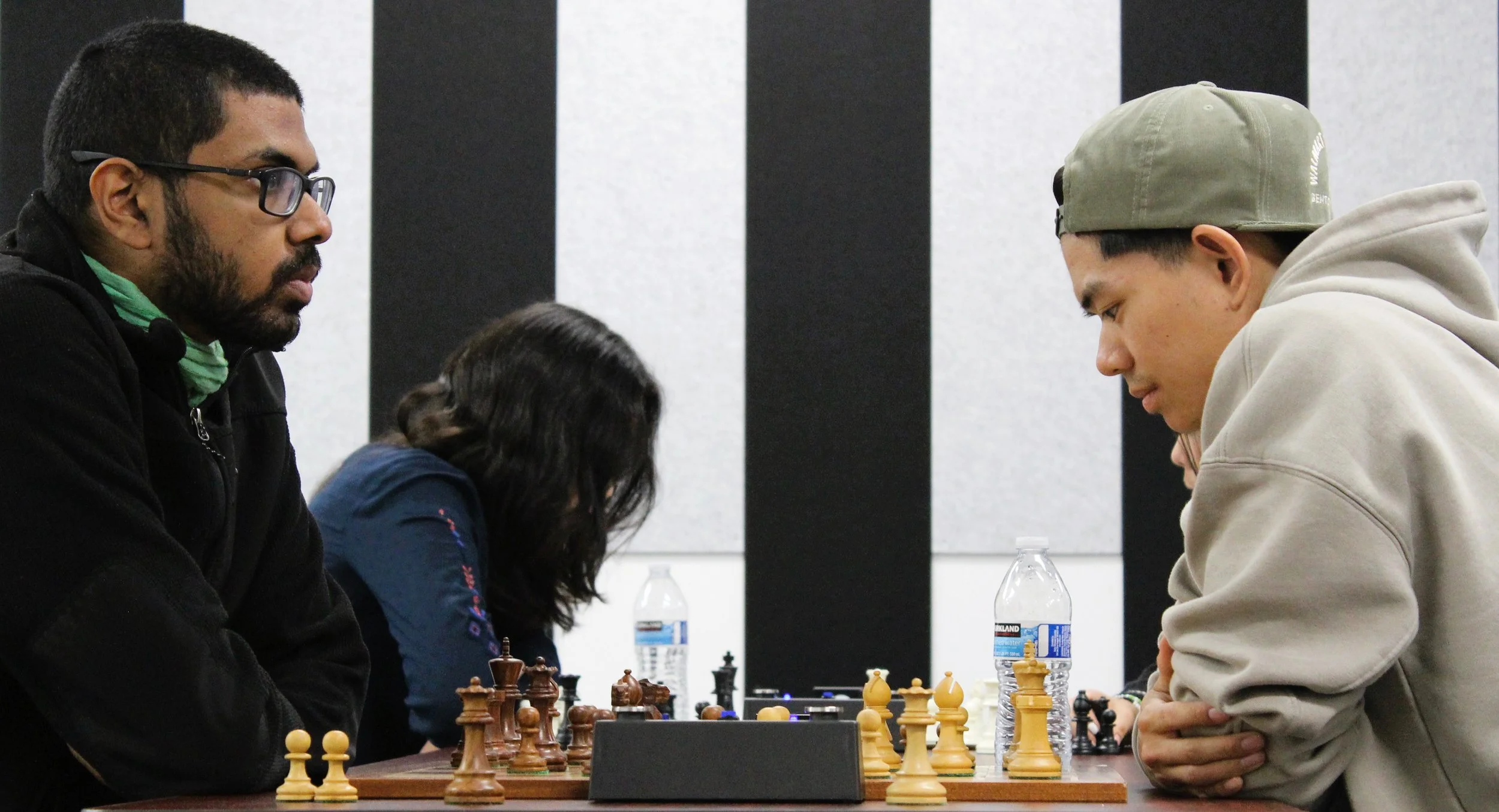
Tournaments
Join our weekly rated tournaments and championships.
Get your US Chess ID and start competing!
Pick the event that fits
First tournament? You will need a US Chess ID. Join US Chess.
Rules & Information
-
Get a US Chess ID at https://new.uschess.org/join-us-chess
In the United States, a player obtains a chess rating through the United States Chess Federation (USCF) by participating in rated tournaments. After playing and completing 4 games against other rated opponents in a sanctioned event, the USCF uses the results to calculate an initial rating for the player called a “Preliminary Rating”. This rating fluctuates as one continues to play in rated events, reflecting their performance relative to other players. In addition to the rating, players are assigned a unique US Chess ID, which helps in tracking their progress, tournament history, and rating adjustments over time. After 25 total rated games, they will receive their “Established Rating” which fluctuates less often. -
Registration is done on our website and closes 30 minutes before the scheduled tournament start time. Players who want to register after this cutoff may receive a first-round bye at the Tournament Director’s (TD) discretion. National Masters (NM) and above play for free in non-FIDE tournaments, please contact usfor registration.
-
Players must be familiar with US Chess rules and have an active US Chess membership. Subject to event limitations, players of all ages and ratings are welcome. By registering, you confirm:
1. Your US Chess membership is active, current, and in good standing
2. You agree to follow all tournament rules.
3. If your membership is expired you cannot play until renewed; if not active by round 1 pairing, the player is provided with bye(s) or withdrawn with no refund. -
3. Ratings, Section Placement & Pairings
-Regular Rating (Monthly) refers to the most recent published US Chess Regular rating.
-Live Rating refers to the current US Chess rating as of the most recently rated event.
-Peak Rating refers to the highest rating ever achieved and is not used for eligibility.
-Section Floor refers to the minimum Regular rating eligible for a section.
-Section Cap (Ceiling) refers to the maximum Regular rating eligible for a section.
-Playing Up refers to entering a section above the one a player’s current rating normally qualifies for.3.1 Section Placement
Players are placed into sections based on their Regular (Published Monthly) US Chess rating as of the tournament start date. Unrated players are placed in the lowest section by default unless the TD approves alternate placement based on verified evidence of playing strength.3.2 FIDE to USCF Conversion Formula
Players with a US Chess unrated rating (never played a US Chess rated tournament) may request placement using a verified FIDE or substantiated online rating. If FIDE is 2000 or below, USCF is calculated as −1073 + 1.5667 × FIDE. If FIDE is above 2000, USCF is calculated as 20 + 1.02 × FIDE.3.3 Scholastic Tournaments
Only students in grades K–12 are permitted to play in scholastic tournaments. Scholastic players may only play up within their own grade category.
3.4 Live Rating Cap Enforcement
Any player whose Live Regular rating exceeds a section’s cap by 150 points or more must automatically play up. -
Inform us as soon as possible if you cannot play a round. Half-point (1/2) byes for all non-final rounds are available if requested before the start of the preceding round. If not requested in time, the bye will be worth zero (0) points. For a half-point (1/2) bye in the final round, players must give irrevocable notice of such byes before the end of Round 1.
If there’s an odd number of players, then someone has to sit out. You’ll still get a win in the tournament, but no ratings change. Byes are given to the lowest-scoring player in the section, with the exception of players for whom it’s their first tournament or players who have a scheduled zero or half-point bye coming up. Refunds are not given or expected for byes. -
4. Playing-Up Policy
4.1 Rating-Based Eligibility
A player may request to play up if
(1) their Regular or Live rating is within 150 points of the next section’s floor, in which case a play-up fee applies, or
(2) their Regular or Live rating meets or exceeds the next section’s floor, in which case no play-up fee applies. Peak ratings may not be used for playing-up eligibility.Examples for a tournament with Open and U1800 sections are as follows:
A) A player with a Monthly rating of 1620 and Live rating of 1739 is eligible to play up.
B) A player with a Monthly rating of 1620 and Live rating of 1647 is not yet eligible.
C) A player with a Monthly rating of 1620 and Live rating of 1809 is eligible with no play-up fee.4.2 Blitz & Quick Tournaments
Section placement is based on Regular ratings. Tournament directors may automatically move players to a higher section if their Quick or Blitz rating is significantly higher. A Blitz or Quick rating may be used only to waive the play-up fee if it is at least 150 points higher than the player’s Regular rating and meets the higher section’s floor.4.3 Alternate Ratings
FIDE, Chess.com, Chesskid.com, lichess.org, or other foreign federation ratings may not be used to play-up if the player already has a US Chess rating. Alternate ratings may be considered only if the player is unrated with US Chess; if a player has a FIDE ID then the conversion formula in 3.2 is used. Substantiated online ratings must come from established accounts with sufficient game history, at TD discretion.
Unrated players must disclose any FIDE or foreign ratings at registration, and the TD may verify and reassign sections accordingly based on our policies. Failure to disclose relevant ratings may result in reassignment, forfeiture of prizes, or removal without refund.4.4 TD Discretion
Tournament Directors reserve the right to deny any playing-up request or reassign a player to a different section for competitive balance or tournament integrity. -
In the first round, players are ranked by their monthly rating. The top half competes against the bottom half. In subsequent rounds, winners face off against each other, as do the losers. This pattern continues throughout the tournament. There is no elimination in swiss style tournaments.
-
2. Refund Policy
2.1 FIDE & Championship Tournaments
A full refund is issued if canceled more than 48 hours before the start time of the 2-Day schedule. A 50% refund is issued if canceled between 48 hours and 2 hours before the start. No refunds are issued within 2 hours of the start or for no-shows.2.2 Scholastic, Blitz & Weekly Swiss Tournaments
A full refund is issued if canceled at least 2 hours before the start. No refunds are issued within 2 hours of the start or for no-shows.2.3 Cancellations & Refund Processing
Cancellations and withdraws must be emailed or otherwise communicated before the applicable deadline. Refunds are typically processed within five business days. Norm tournaments follow the refund policies listed on their individual registration pages.2.4 Competitive Pass or Premier Subscription Players
Missed events are not eligible for refunds. Missed tournaments without prior notice result in:
(1) a warning for the first offense,
(2) a one-month subscription suspension for the second offense, and
(3) loss of eligibility to use any subscription benefits that provide full tournament entry discounts. If a player uses a Competitive Pass or Premier Subscription registration code
Registrations made with a Competitive Pass or Premier Subscription code are only valid if your pass/subscription is active on the tournament date. If you cancel, entries remain valid only for tournaments occurring within your current billing period; tournaments after cancellation require the standard entry fee or reinstatement.For example, If you register while active, then cancel a week later, any tournaments after the cancellation date are no longer valid unless you pay the standard fee or reactivate.
-
You DO NOT have to bring anything. We provide notation sheets, pencils, chess boards, and clocks. It is recommended that you bring water bottles. We have snacks and drinks for sell onsite.
-
Among median tiebreak methods, this approach is widely used. It evaluates a player's competition strength by summing the scores of their opponents. Players with an even number of wins and losses discard both the highest and lowest opponent scores. Those with more wins discard the lowest score, while those with more losses discard the highest. In tournaments with nine or more rounds, the top two, bottom two, or all four scores are omitted, depending on the player's win/loss ratio. Unplayed games are counted as half a point each. If a tied player has unplayed games, those are treated as games against opponents with a score of zero.
-
FIDE-rated tournaments differ from US Chess-rated events in their rating systems and international scope. FIDE uses the Elo system globally, while US Chess focuses on American players. To get a FIDE ID, play in a FIDE tournament and complete the registration form. We’ll handle the rest.
To participate in FIDE tournaments, players must complete the registration form and obtain a FIDE ID, or contact US Chess to request one. An official FIDE rating requires at least five games against previously rated FIDE players, a minimum score of 0.5 points, and a performance rating of 1400 or higher.
-
Touch-move rules are in effect. If you touch your piece, you must move it; if you touch your opponent’s piece, you must take it. If you want to adjust a piece, say the words “I adjust” BEFORE touching it.
-
To withdraw from a tournament, please email info@texaschesscenter.com or complete the form on our website at least two hours before the event's start time. Refunds are available if requested up to two hours prior to the tournament's start. Refund requests made after this time will not be honored.
-
Spectating is not permitted after your game has concluded. You must leave the tournament hall, close the door behind you, and record the results on the pairing sheet. Communication between spectators and players is prohibited once the game has started. Any form of outside assistance may result in severe penalties. Do not walk into a tournament hall while games are in progress if you need an item to be dropped off to a participant. Kindly ask a Tournament Director and they will take the items to the player.
-
In the event of any claims, pause the clock with the center plastic button and come find a TD.
-
When you’re done with your game, reset the pieces and mark your result, on the same sheet where you found your pairings in the first place. 1 for a win. 0 for a loss. ½ for a draw.
-
All cell phones must be placed face down on the table, visible to both players, and turned off (not on silent). Apple Watches, smartwatches, and other wearable devices must also be placed face down and turned off.
Disruptive noises, such as cell phone ringtones, notification vibrations, alarms, and other sounds, can disturb the playing hall. These noises are often loud and disruptive to the entire room. The following penalties apply for such disruptions:
First offense: The standard penalty is to subtract half of the remaining time from the offender's clock.
Second offense: The player loses the current game, receiving a score of 0 (not 0F).
Third offense: The player is removed from the tournament with no refund. -
If you need to use the restroom, leave your device(s) on the table. If you need to go to the bathroom during your game, you may not pause the clock. You can go during your opponent's move, but once they hit the clock you will lose time.
-
Keeping notation is not required in the <beginner> sections, and is not required for either player if you or your opponent gets below five minutes. (If time control has a 30-second increment or more: Scorekeeping is required EVEN IF either player falls below five minutes.)
-
Here is a list of common penalties:
Addition of 2 minutes to the opponent's clock
Reset to previously notated position
Removal of half remaining time up to 10 minutes
Automatic loss of game
Removal from round
Removal from tournament
1 Month ban for all TCC Tournaments
6 Month ban for all TCC Tournaments
1 year to life-long ban of all TCC Tournaments
-
On your turn, please press the clock with the same hand you moved with, AFTER moving your piece.
-
Disruptive behavior will not be tolerated. Players who engage in repeated or serious violations of the tournament rules may be subject to penalties, including removal from the event.
Competitive Play Pass
Play chess often?
Get 100% off weekly Swiss tournaments, Open Plays, and more!
Game of the Month Submissions
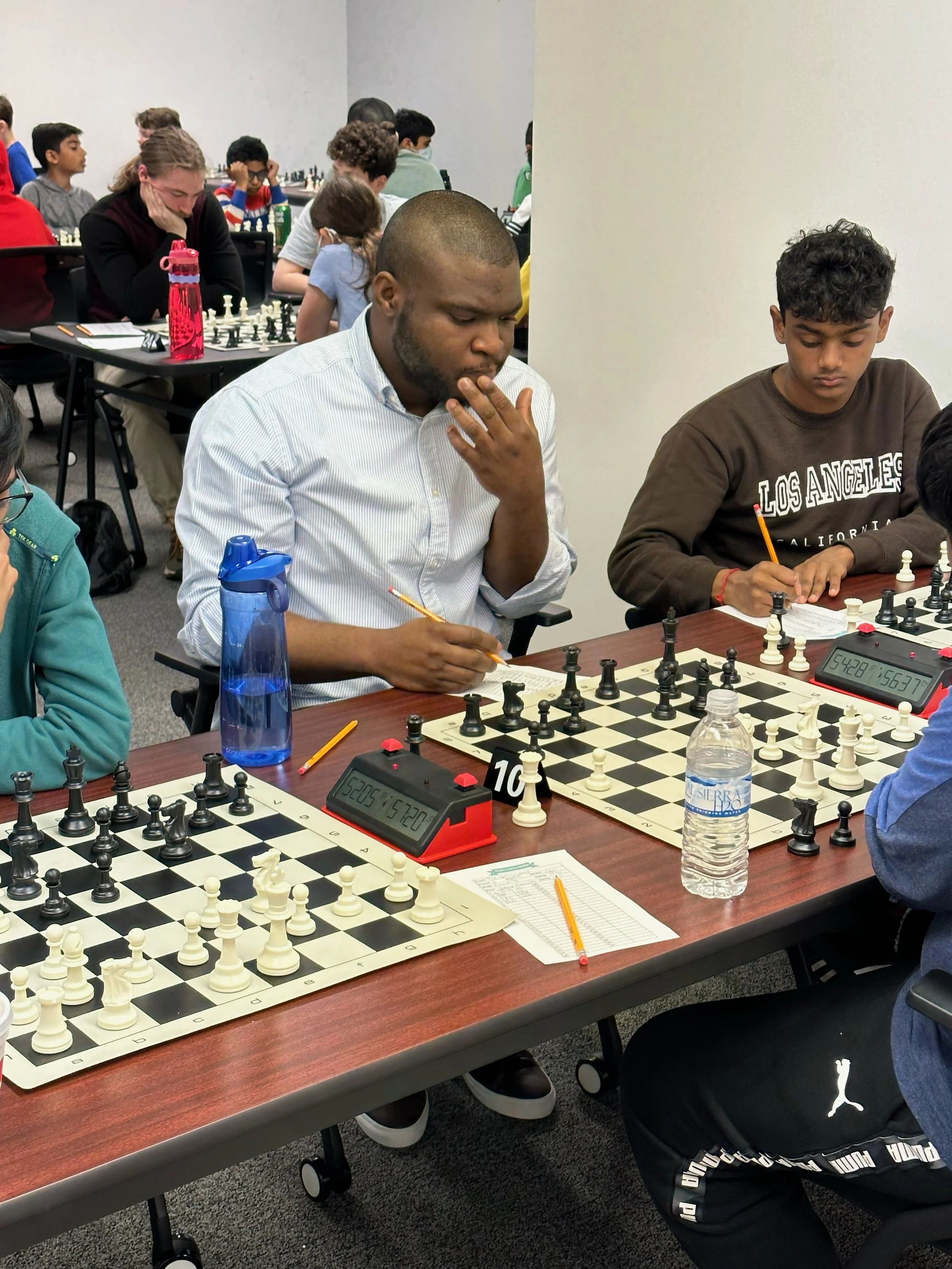
Do you want your game to be featured in our Newsletter or on our social media? Fill out this form with a copy of your notation sheet, and it could be you!